Monday, April 11, 2011

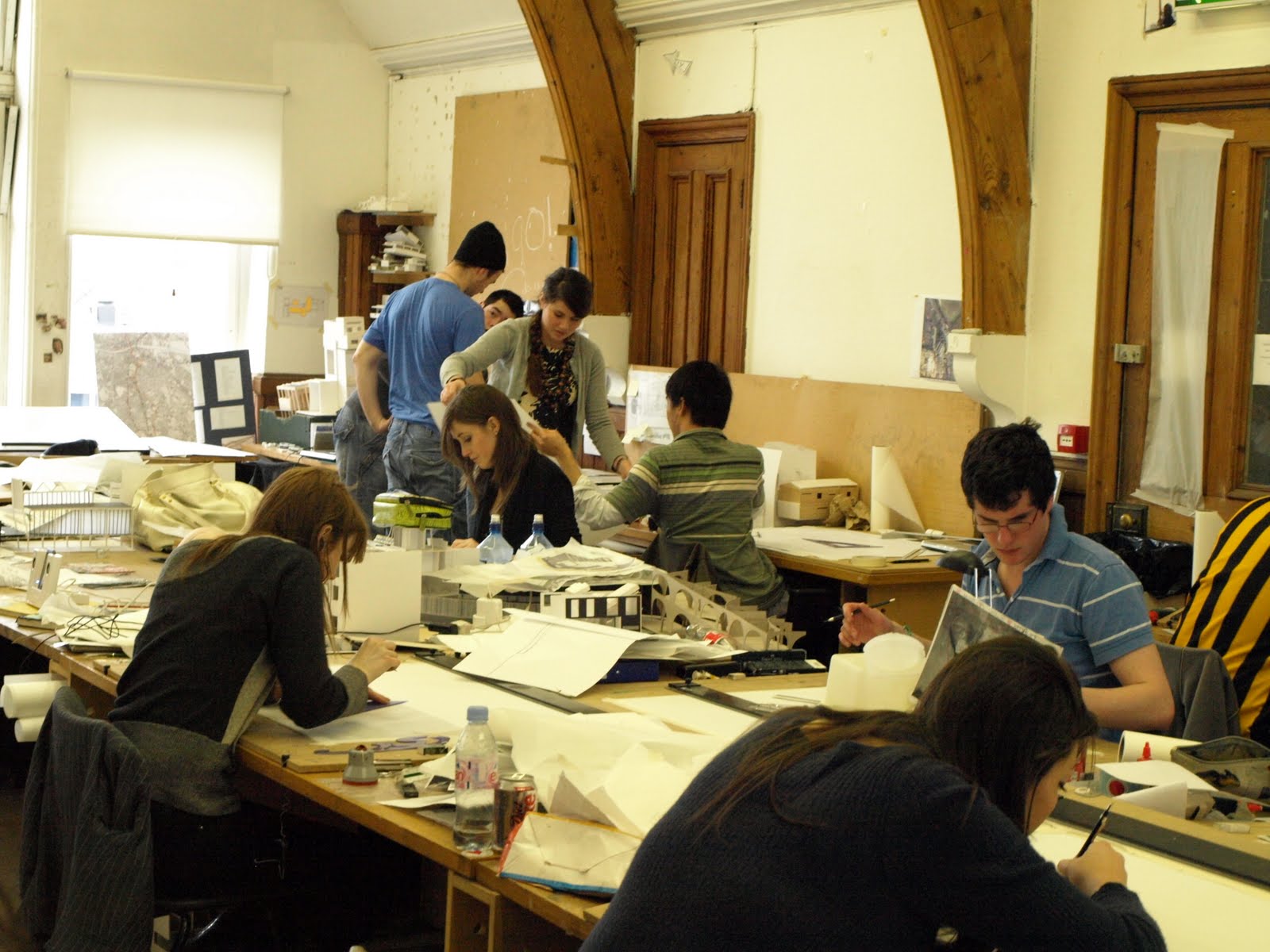
Space Framed Week 10


Just a reminder that there will be no space-framed session today.
We are proposing a final session next Monday at 13.00, a review on Wednesday 27th in the morning, and a final submission deadline of Monday 16 May at 12 noon. 
Next week, you will present a summary of your research and work to date with a proposal and work outline for the review on the 27th.
Please post any updates on your project on the blog, and email me any queries you might have.  

Sunday, April 10, 2011

William Eggleston and his way to document the daily human habitat


With his photographs William Eggleston succeeds in documenting the human habitat familiar as well as well as unknown.
He documents his life and his impressions, but it’s everything else than an autobiography in a chronological classification.
There is a lot of interpretations scope for the viewer

At first his photographs look like snapshots of an amateur.
But the photographs of William Eggleston memorize.

Why is it like this?

Is it because of these actually really daily motives?
Is it because of the uncommon perspective in some of his photographs?
Is it because of the eye-catching colors and this special technique called dye-transfer-process?
This technique allows William Eggleston to subjectively control colors like a painter.

I want to get to the bottom of the question, what make these photographs so special and how is it possible not only to document human habitat, rather to describe it.

In the end of my essay I want to compare two different styles of documentary photography. On the one hand there is the photography of William Eggleston; the snapshot documentary.
I think especially in the work William Eggleston we can realize that spontaneous unpredictable things in photography could be really important and could develop a deeper statement.  

On the other hand there is the photography of Bernd and Hilla Becher. They know exactly what they want to show. They know where, when and why.

Finally I can summarize that my essay is going to be an examination of the person William Eggleston, his form of daily documentation of human habitat and a comparison of his work and the work of Bernd and Hilla Becher under the aspect of documentary photography.


Alice, you asked me to post this ages ago, Apologies


BACK TO PAPER: relative spaces

Brian Barber 2010

RELATIVITY


‘a state of dependence in which the existence or significance of one entity is solely dependent on that of another.’1


A house consists of a sequences of volumes arranged
in relation to each other according to function and form. Each
room is relative to each other creating a sequence of spaces.
The person inside the building can connect these spaces to each
other by memory. This memory influences the perception of the
next space and influences how you recall the previous space.


‘Memory is recalled to admit continuity into a context of change’2


The attributes of an architectural plan drawing,
enable the architect can occupy a series of spaces at once,
albeit in a two dimensional way, and does not rely on memory
to link sequences together. With photography our perception is
limited to the field of view. However by composing the image
that cannot be seen in reality, be it divide by time or
physical parameters we can gain a greater understanding of
relative spaces This occupation of a series of spaces at once
in my photographs allows comparisons, analysis and an
experience to be translated in a single image.
The images layers crate a physical memory.

To evaluate the worth of a single image to describe


_ dogtrack


This picture is composed of a series of images that are relative to each other but are separated by time. From left to right the image describes the crowd through the length of the 31 sec race. From people not looking at the track, to the excitement just before the traps open, looking for the kick around the first corner, relaxing slight towards the middle of the race and the dogs their furthest away from the spectators, the cheering on at the final bend and the joy or disappointment at the finish line and finally the loss of preoccupation with the track. This experience of the race could not be captured in one transient image, however by linking these series of photographs together, the whole 31 seconds of the race can be perceived by the photographs observer in a coherent way.


_His fridge

A drawing can accurately describe scale. Spaces are seen in relation to each other; however in experiencing a space, other influences can alter how you understand size. I wanted to create an image that we could not see in reality. I became interested in everyday spaces we see but we could really understand. The section through the fridge accurately describes its scale. By blacking out the rest of the room we can, perceive its scale in isolation and appreciate its true size in relation to fixed reference point(the participants head).the image in the exhibition is printed at actually size so scale can be appreciated. This picture follows my way of analytically studying space. Instead of seeing a space in relation to each other, to fully understand its scale we must see it in isolation.


_working traps

Showing a single space over a period of 54 seconds and the different ways it is interacted with from the loading of the dogs, the pause before the release and finally the sprint from the trap

_Train line

There is one image that exists in reality, however can never be seen. This is the sequence of spaces before you get on a train, the train itself and the sequence after. These spaces are separated by time and distance. By composing this picture out of a series of images this space was formed. As with a drawing, comparing scales and contrasting the physicality of the place is possible, however the photograph can describe more. The physical three dimensional world, how people operate in this space, the weather, the lighting conditions are all illustrated. As with the attributes of a architectural drawing, you become able to occupy a series of spaces at once and begin to understand how each space would be experienced as you travel from one to the other


1 http://dictionary.reference.com/browse/relativity (13/05/2010)
2 Taka Architects, TA. (2008)’Mnemonic Tectonics’.In: Campbell,H, Martin-McAuliffe,S, Ward, B, Weadic, N (Ed.)
(2008) The Lives of Spaces. Dublin:IAF and UCD

Sunday, April 3, 2011

WORKSPACE


The Comedy Of Etiquette

Offices expect a certain etiquette. The professional must be business like at all times, this no extreme behaviour of any kind. Serious but not

cold, hard working but not stressed, friendly but not overbearing. Small talk in the break room can be the high point of the social contact as busy workers ignore one another around the office space for fear of being branded a slacker. Human nature prevents people from being perfectly professional all of the time, and when personalities emer

ge it can feel out of context. However it is these moments that make the workplace a human dwelling. A

tired worked may take his shoes off under h

is desk revealing cartoon socks under a grey suit. A joke circulating can break the serious tone. Or a flustered woman can run through the office in her pencil suit and heels, neither of which encourage movement. It could be interesting to search for moments where the clinical office etiquette breaks to show the human habitat it is.

The Desk - barrier, habitat, sanctuary

The most personal space in the office is your desk. With others rushing around it becomes you private space to

get lost in your own thoughts. Each desk it arranged for its user. Layout and content can be a revealing insight into that person. They could be tidy or messy, have family pictures of m

agazine cut outs of thei

r favourite car, do they sit facing the person opposite or intentionally turn away. Each workspace has the unconscious fingerprint of the user. Desks also work as barriers. They separate which gives that sense of privacy. They also show hierarchy. The desks of the office change according to rank. The boss gains authority sitting behind a large desk that is unshared. This leads into the progression from cubical to office to bigger office. In an office one of the things the working strives for. The feeling of importance from you own roo

m. The desk has many different possibilities for investigation. I could either investigate desks from the angle of personal space and how each one is unique. How different professions react to the workspace is also interesting – how no matter the job, we all make the space our own. Or maybe how the desk separates and protects us in the jungle of the w

orkplace.


The Computer

Lee Friedlander took a very interesting series of pictures of people at their computers. Blank expressions deep in concentration staring at the screen. One of the major changes of our time is the introduction of the computer and its dominance in every aspect of out lives. Once architects used drawing boards, now its all computer. Other professions have transformed in a similar way. Despite its definite advantages what Friedlander shows is how the computer can take the activity away from work, and in a way make it depressing. We no longer need to move around the way we used to. Another way of looking at it is that our computer is all we need as a workspace, and it is portable. People can open their laptop and suddenly coffee shops, benches and airport lounges become offices. People get equally lost in work at a coffee shop table as in an office block. It condensed the workspace and means we never leave it behind. Iphones mean emails are accessed as soon as they are received, meaning we are never really disconnected from work. How people interact with the computer is an element of the workspace. The portable office could also be worth attention.

Monday, March 28, 2011

This week, through the work of Tod Papageorge I analysed the urban benches in Central Park. He is an american art photographer and published in 2007 “ passing through Eden ” a collection of images he took over 25 years. I was interesting by one part of this book where he presents a series of bench photographies.


Every day we have some opportunities to sit down on the bench in the private or public interior place or in the urban space.On the first time I’d like to mentioned the importance of material used for the design. In Central park , the bench framework is built by steel or concrete, the back and sitting set up by piece of timber. The choice of material has to be specific because it influences the shape and the strength of the design. Besides I think that it’s essential for designer to think about the “ surface appearance ” of each material as well as its temperature to promote the best human comfort. The other features are the global measures , depth , length,height. All of these components influence the usefulness of benches in the interior and urban space.


In the urban planning , each furniture have a particular disposition and direction and manage ours activities and attraction. Through the Tod photography I can make out three type of bench practices.


“ the stop bench “ where people make a break

“ the wait bench “ where people wait someone

“ the pleasure bench “ where people make a pleasant and relax activities.


All of these activities involve a particular posture and human behaviors and I think that some factors influence it, like the global design and several social elements. Indeed, men and women often haven’t the same position in the bench and the design must be adapted to the liberty of human body. The different culture and sex of people influence the practice of bench and I can identify benches like a “ social furniture “ where charming incident take place. In the Papageorge photographies , the majority of sitting are long and promote meeting between stranger, young and old people. But through his picture we can see that people sometimes share the same bench without more attraction and discussion. However it’s also funny to observe that people often choose the same bench and the same place. I think that it’s important to mentioned that benches become a personal sitting in the public space where we can maintain ours habits. Moreover since 1986 there is a new concept in Central park called “adopt a bench “, a project where people can buy their bench and write what do they want on the small metallic plaque. I’d like mentioned again the social implication of this furniture in the urban place. Indeed through this project people can enter in the life of strangers and share a part of memory.


To progress in my study I’d like to compare the interior bench space (airport space and private space) and explore how the surrounding can be influenced the behaviors of people.


The man behind the Machine


Having studied the photographic styles of Abbot and Baltz in closer detail, the idea of capturing the human effect on landscape inspired me most, to create an analogy beyond the survey. Both took worlds which are familiar and isolated fact, Baltz devoid of personal prejudice and Abbott's infused with emotion. I would like to juxtapose both styles. I have always had an interest in industrial landscapes, the unusual forms, noises, smells and robot like movements of the humans that inhabit these spaces. The people become the machines. I am intrigued by the Dublin Docklands. It it is a secret world, hidden from society, a walled fortress which never sleeps. A mini city with its own infrastructure where land and sea have a mutual dependence.


Human habitation is evident by the order of things; stacked containers or rows of cars in a parking lot. It lives and breaths efficiency. A fluorescent safety jacket on a chair in a security hut is the only indication of human presence within that space. People do not walk on these streets. The footpath acts as a threshold, a large curb. The cabin of the machine becomes the room, a mobile office, inhabited space. A trail is formed from loading bay to canteen, a ritual pilgrimage for the workers. Long canteen tables lined with benches and chairs emulate the rigid ordering of the docklands only broken by littered paper cups in the same way silos rest among steel boxes.


A steel ramp forms a bridge from boat to land. Cargo is loaded and unloaded, everything has a destination and a place. The worker overlooks and takes part in this procession. Their life although surrounded by people is isolated, conversation is minimal due to constant noise. There is a unified code, a seperate language for this place. Its identity is formed within itself. There is no hint as to where this place exists, it could be anywhere in the world.


Allan Sekula has captured a non romantic image of the docks, the workers and fishing in his book '
Fish Story'. His images are highly sensorial. He uses flash photography and atmospheric lighting to reinforce the human markation of these terretories. The subject matter varies but maintains a running theme. The images are arranged to tell a story. If they were shown alone one could interperit anything from them.
Taking Sekula's idea of relative matter I would like to create a story of the Dublin Docklands in a similar fashion. I would like to create an analogy of the man behind the machine, to try and capture the alien like quality of docks life in the 21st century. I have started by photographing the routes and inhabited yards along with the machinery. My next step is to trace the movements of the worker and the machine and lastly to focus in on the worker and their habitiation of sole and communal space.

I have also looked at Jean Gaumy's 'Men at Sea'. Gaumy joined the French Fishing Vessel on one of its voyages and maintains a written diary. The images are hugely atmospheric and truely capture the essence of life on the sea. Again, I would like to emulate Guamy's approach to photographing manual workers in their habitat.

Sebastiao Salgado's 'Workers; An Archaeology of the industrial age takes an account of the manual labour from cocao to tobacco plantations. Man is the machine.


Sunday, March 27, 2011

Further Development


As was mentioned last week, my initial investigation into the housing estates of Cahir was heavily research based and confined to the documentation of form, or at least elevation. At the time, I had Walker Evans' series on Victorian Architecture on my mind, and I while it was a worthwhile exercise, the style and format of the images proved limiting.
During my second round of photography, I began to deviate slightly and began photographing the corners of housing rows, the gaps and views in between, and the relationship of building to landscape.


However, while these might have been diverging interests, each image was still ultimately concerned with form and space, without any real sign of occupation or the actual quality of that occupation. Also the method of taking remained consistent, maintaining a high aperture, low iso and consequently slow shutter speed.

I think though, I have a fair idea where I want to go next. Having looked at the work of William Eggleston in his publication "Los Alamos", I'm interested in how he captures a range of everyday objects into a unified visual world, perhaps thanks to his unique use of colour. More particularly though, I'm inspired by the range of his subjects and styles which seem to vary from the documentary to the highly subjective, and from personal portraits to non-specific human landscapes. Yet somehow avoiding a messy eclecticism.


I think this project could be focused on a single concept (albeit a rather broad statement):
If the housing estate is just a place where people live, then what is it like to live in?
Is it good? bad? or really, really average?
Where do kids play? Where do neighbours talk? Where's all the stuff beyond the houses... the washing lines, the strewn toys, the dirty boots and garden furniture?
Whatever emotions and opinions exist perhaps the point is that they're far more kaleidoscopic than presumed and that a greater range of photographic techniques and subjects may be required to express this.
I can't help but think that the face it shows to the world is not all the estate is, or could be.


Monday, March 21, 2011


Robert Frank - The Americans

Robert Frank, a Swiss born photographer working primarily in America, is best kown for his 1958 photographic book ‘The Americans’. This book culminates an approach to photography including; the purposeful production of books to display his images in a loose narrative “to be read and re-read like a poem”; an almost irreverent off the cuff style of shooting and a particular existentialist attitude that resulted in a questioning social commentary to much of his work.


Mary's Book


Even at an early stage Frank was compiling his work into handmade books, like that made for his girlfriend Mary in Paris and ‘40fotos’ a book which he used as a portfolio, which got him through the door at Harper’s Bazaar in New York where he worked under Alexis Brodovitch as a fashion photographer. Just as his career in New York was Starting to take off, Frank left for Peru and the Andes. Here, Frank learnt to be a mute outsider looking in on a place and society. He could not speak the language and was unable to engage with his subjects, not that he aimed to, this forced a way of working as an outsider making sense of his surroundings through images alone. Peru was revelatory on a technical level for Frank also; although proficient with most cameras, the Leica allowed him the freedom to pursue his subjects that others didn’t. This could partly have been a reaction to the perfectionist approach to technique he would have experienced while apprenticing in a landscape photographers in Switzerland, in much the same way his contemporaries and friends in the world of abstract expressionism were reacting against the perfectionism of their European heritage. Frank is often said to have been shooting casually without framing the image with the viewfinder but allowing his hand to find the image. He often crops to the edge of an image and isn't concerned with perfect techniques.
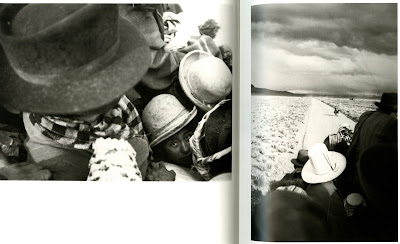

Peru


With the help of Walker Evans, who employed Frank at Fortune magazine, Robert eventually got a Guggenheim Fellowship in 1955-56 which allowed him to travel America and pursue his emerging subjects of interest to make 'The Americans'. Frank shot over 28,000 images in all, which he would constantly make contact sheets from to help inform and refine his search in the field. From these he selected 300 images to print and only 83 were used in the book. Subjects included symbols, cars, cities, people, signs, cemeteries and others. The book was arranged in sections each starting with the image of a flag. He wanted the sequence of images to have a cinematic effect, with ghost images that would inform the reading of subsequent images. If Bresson sought to represent all the complexities of life in a single image, Frank sought images with a more singular message that would gain complexity when combined with others in a book.

By this time Robert Frank's initial excitement with America life had grown into a skepticism, a sentiment reflected in the existentialist beat culture of New York, of which Frank was a part. Jack Kerouac, a well known beat writer, wrote the introduction for the book and Frank was already making films with the those in the beat scene. The book aimed to investigate contemporary American society but had undertones that were not always palatable to most Americans and it was heavily criticized. It was said that his book was 'an attack on the United States' and even after he eventually found a publisher it was not an initial success. Much of the images were investigating issues like race and the power of the state over individual freedom. His questioning approach can be clearly seen in much of the motifs used in the book (figures from behind, lone figures in a crowd looking toward the camera, cars, figures in hats but certainly in his use of the flag, not as the typically idealized symbol of a nation and proud patriotism but often cropped and awkwardly draped, oppressive and almost malevolent.

Frank went on to make films and a handful of other book projects but he often returned to the Americans and re-cropped images or reprinted them adjusting their exposure and composition.

Sunday, March 20, 2011

Photography and the Human Habitat - PROJECT PROPOSAL


1 ; 4 - Tod Papageorges
2 ; 3 - André Kertesz
5 - Garry Winogrand


In the course of my architecture studies in France and in Ireland I learn to work at different scales. Architects must be curious person and they have to explore the human life to create all of appropriate space ( exterior, interior, urban and human spaces ).

At the beginning of the semester I studied the work of Garry Winogrand. After this first analysis, I was interesting by several photographers who work about the street and public relationship between people and their city.

For the project, I propose to work on the photography of the public space and I'm wondering how design of urban furnitures influence the human posture in the street.
Step to step I discovered the work of Garry , Tod Papageorge and André Kertesz and their photos of strangers in public place. They are tree Americans photographer and explore the global street atmosphere . Through these pictures , it's really interesting to see how people live together in the street. It's for this reason that I would particularly work on the urban sitting space. Indeed , if we attentively observe the city , there are different type of sitting, " natural " and " artificial " sitting. I mean by artificial, sitting built by designer.

André Kertesz photographed people on the benches and chairs in the street and studied the chair furniture itself and its urban implantation. Tod Papageorge shows how people find and exploit themselves the sitting in the city. In these photographies I perceive a visual noise and I'm interesting by the moment where photographers capture the movement and interaction between posture of people and the urban surrounding.

At the end of researches , I would like to show a series of picture, like a documentary book which explore the contemporary city life.


Art does not reproduce the visible rather it makes visible.


Project Proposal_Philipp Gengenbach

When I was looking into the work of Bernd & Hilla Becher I came across the quotation of the famous painter Paul Klee: „Art does not reproduce the visible rather it makes visible“.

Photography is an art, so it could also be called: „Photography does not reproduce the visible rather it makes visible“.

I think this sentence describes the photographs of the Bechers in really good way. But it applies not only to the photographs of the Bechers. Also a lot of other photographs we were looking at in this course are characterized by the documentation of daily things which happen in our life. We are completely used to it and only because of the photographic documentation we begin to think about it and maybe we recognize the specialty of these things. 

I was really impressed by this statement of Paul Klee and it was helpful for a better understanding of a lot of photographs we looked at in this course. I started to look at some photographs in another kind of way.

The art of photographing not only the very special things but rather the things whose specialty you could first recognize at second glance is very interesting.

My Project Proposal should be to analyze some photographs related to this statement of Paul Klee.
I would like to pick some photographs of the photographers we were talking about but also I will try to take some photos by myself which show daily stories in the human habitat.

Tuesday, March 15, 2011

WHAT MAKES A SPACE A HABITAT?


Photographys ability to make us re-evaluate our environment is one of the keys to its success. Throughout the course I have found myself drawn to the photographers that take the ordinary and extract beauty where others see nothing.

Eugene Atget photographed Paris with a no frills style that revealed more about the city because of its honest, non-judgemental approach. He did not adapt scenes to express an opinion, but recorded what was there as a casual observer to create an overview of the city. I am interested in how his pictures focus on the human interventions in a place, but are mostly devoid of people.

Bernd and Hilla Becher photographed industrial buildings and displayed them beside each other, creating a typology for what would be seen as awkward and alien structures. By representing the unique as one of many the strange shape become the norm. This method of photographing different objects using identical photographic techniques to highlight similarities is applicable to my proposal.

Stephen Shore embarked on a cross country trip which he photographically documented. He photographed the beds he slept in, the toilets he used and the fridges where he kept food. This approach captured the human effect on space. Signs of human activity make a space a habitat.

For my project I began to think about habitat. I was drawn to the one space I use most, my workspace. As an architecture student I could spend hours at my drawing board, without realising it I have cultivated a habitat around this 2m x 1m desk. We think of the home as a habitat, we spend a third of our days at work. Our workspace is as personal as out homes. Francis Bacon's studio is now on display in the Hugh Lane Gallery. His workspace had over the years becomes an extension of himself and gives us a deeper understanding of his mind and work. Even in the most sterile of offices stationary, keyboards etc are arranged to the users specific preferences. I want to document a variety of work spaces, particularly desks comparing and contrasting how people personalise them. I want to investigate what makes a space a habitat. By photographing work desks in a documentary style and displaying them in a way that they can be compared I hope to achieve this.