Wednesday, May 1, 2013

The city, underground.


The relation between SUBJECT and IMAGE.
- Walker Evans, Luc Delaheye, Bruce Davidson and Michael Wolf

After studying these 4 photographers a little closer, and more specifically their series of subway photography, a thing I noticed was the photographers relation to the subject.

Evans and Delaheye uses the same method of a hidden camera in order to photograph people unaware of the situation. The motionless images allows us to linger in the faces of ordinary people, which the social rules of society won´t allow us in public.
on the contrary Davidson and Wolf is very much in your face photographers.
Davidson directly asks people if he can take their photo and their by gain a sort of reconstruction of the scene he was interested in to begin with.
And Wolf takes the photos as the train doors shut close on a stuffed subway. He´s object are unwilling participants in the images, and he gains that imitate reaction on peoples faces when you invade their personal space.

So the question is then - as I noticed in the last post – do we learn more about a person form them not knowing or from allowing them to participate?

Code inconnu, Michael Haneke, 2000

Luc Delahaye
L'Autre, 1999

"I stole these photographs between ’95 and ’97 in the Paris metro. ‘Stole’ because it is against the law to take them, it’s forbidden. The law states that everyone owns their own image. But our image, this worthless alias of ourselves, is everywhere without us knowing it. How and why can it be said to belong to us? But more importantly, there’s another rule, that non-aggression pact we all subscribe to: the prohibition against looking at others. Apart from the odd illicit glance, you keep staring at the wall. We are very much alone in these public places and there’s violence in this calm acceptance of a closed world.
I am sitting in front of someone to record his image, the form of evidence, but just like him I too stare into the distance and feign absence. I try to be like him. It’s all a sham, a necessary lie lasting long enough to take a picture. If to look is to be free, the same holds true for photographing: I hold my breath and let the shutter go."  - Luc Delahaye, L’Autre, Phaidon Press, London, 1999


L'Autre, untitled 

Luc Delahaye is a french photographer who started as a photo journalist in the 1980´s, he is particularly known for the work he did doing war in Afghanistan, Lebanon and Yoguslavia. In the beginning of the 1990´s he started to question the work he was doing; “ I had lost my faith in photography and I wanted to understand what it really is about. So I decided to see what would happen when no photographer is there, just the subject and the camera”
His first more contemporary project was “Portraits”. A project were he would ask homeless and poor people to have their portrait taken in a photo-booth, and thereby removing himself from the process. “They sat in this cramped booth while I was looking away; in the solitude of their experience they were confident in the machine, they knew it´s power of revelation. Those who have lost everything in life have nothing to hide, they are naked.”
His next project was L'Autre. For almost 2,5 years Delahaye secretly photographed passengers on the subway in Paris with a hidden camera. In order to take the images he pressed the shutter as the train door closed and photograph the person sitting in front of him. In that way the camera would not be heard and the object would not react. He then cropped the images to only show the faces and a little of the background, so that each face seems locked in a mask.

L'Autre, six cropped images.

Jean Baudrillard states in his introductory essay to L'Autre; “No-one is looking at anyone else. The lens alone sees, but it is hidden. What Luc Delahaye captures then isn´t exactly the Other (L'Autre) but what remains of the Other when he, the photographer isn´t there.”
The series explores a relationship between the photographer and the object, such as the american photographer Walker Evans did it in the 1930´s - by photographing people sitting opposite him with a hidden camera. The photograph then captures an anonymity between subject and camera.

The guard is down and the mask is off, even more than in lone bedrooms where there´s a mirror. People´s faces are in naked repose down in the subway.” - Walker Evans

Walker Evans, Many are called

By hiding the camera the subjects do not look at the photographer, but maintains their private space. The subjects mouth are slack, their eyes are unfocused and their features are not made up for a pose.
But when you study the images the faces are no longer passive or unaware, but withdrawn like they are hiding something. We attempt to put ourselves in their place when looking at the image, in order to understand them - and maybe in the end understand more about ourselves. We try to read a meaning into their faces, and force a significance onto them.
Baudrillard writes: “There’s the same reversal everywhere, expressing a fatigue on the part of the subject, a weariness of being oneself and asserting oneself. And also the secret confused demand that the Other should think us, that the objects of the world should think us”
L'Autre, untitled

On the road


On the road - Bert Teunissen

(spell checking in progress)


Bert Teunissen’s most famous project Domestic Landscapes, a serie of photographs of European homes built before the World War II and their inahbitants, leeds the Dutch photograph to cover over 50 000 km of roads around Europe. More than a way to reach his final goal, he considered the road as a trip on its own. His book On the Road is a collection of picture taken during his travels.


“It brings me to my destination,
It is both the bridge and the barrier between me and my destiny,
It is inviting and defiant at the same time,
It is in front of me and behind me,
It can be smooth or rough,
it is the vein of my world.
When I’m on it, I’m on track
I follow its source where I will find my treasure,
And Then it will bring me back home again“


Pictures are in black and white in a 18x24 format. He took the pictures of the landscape while driving. They are framed by car furniture (wheel on the bottom and sun visor on the top), with a least one hand visible. Comparaison with Lee Friedlander’s and his project America by Car is inevitable, but both seem to reach a different goal. Friedlander focuses on landscapes, buildings, people or urban details. Car and roads are the frame, they emphasize the subject. In Teunissen’s work, the trip himself is the main subject. Photos are by the way not situated. They don’t have any legend, and may be taken everywhere in Europe. Only naturals elements such as sunshine, snow on the road or rain on the windshield vary. Even the windshield blurred in the middle of some pictures doesn’t disturb the main topic of the work, evocated by the artist himslef in the beggining of the book : a personnal reflexion about the destiny and the way to reach it.


The style chosen by Teunissen may refer to the documentary style. Procedure is very systematic, all the pictures are made from the same point of view (form the driver seat), looking straight ahead on the road with no external elements to disturb the view on it. All the picture are in black and white, in low resolution and printed on cheap sheets of newspaper. The final book is rolled up in a cardboard box. 

But despite the very systematic procedure and the references to the journalistic style,  Teunissen’s work is fare from documentary. Separatly, pictures are anonymous. No detail allows us to say where or when the picture is from. But the artist show them in couple, two pictures in one page. Sometimes the two pictures are formally really closed (trees on the side, infinite perspective...), sometimes they are not. But put together, they seem to tell a story, to refer to Teunissen’s own experiences when he had cover European roads to work on his Domestic Landscapes project.

He said about it "Traveling to Bulgaria for instance is a three day journey just to get there, and then the work starts. But three days in your car - that’s a trip on its own. Traveling through a country where you’ve never been before and meeting all these people and seeing all these things... I felt like I needed to do something with that experience. I couldn’t just do it and only go for the Domestic Landscape and then come back home with nothing to show for where I’ve been. [...] I’ve been doing it for years. It’s the joy of looking. That’s what it is for me".


On the road appears like a really personnal work. It looks first of all as a thanks to the road he had to take, not as a pragmatic way to reach a place from anothor one, but as an important part of his artistic process.


Tuesday, April 30, 2013

Exposed


Exposed


Flash photography brought a whole new meaning to the saying, ‘A picture is worth a thousand words’.

Looking at works by Arthur Fellig, ‘Weegee’ and Kohei Yoshiyuki, the exposure of these photographs give us a greater depth of the story that surrounds the subject in the image. The flashlight over exposes the whole scene, essentially turning the light on the surrounding context, making what is normally invisible, visible. 

Weegee brought out a book called ‘Naked City, 1945. This is a documentary book of Weegee’s images up to the mid 1940’s. 

Weegee, a freelance photojournalist documented images for tabloid attention. He worked by himself, cruising the streets of New York using a 4 by 5 Speed Graphic camera with a Kodak Ektar lens in a Supermatic Shutter with flash attachment to highlight a scene for the next breaking news storey. He used the boot of his car as a dark room, processing the print before selling it to the local papers. 

Instead of the usual ten foot shot other tabloid photographers would take, Weegee would sometimes take a shot a hundred feet away so as to get the whole scene, dramatising and at the same time humanising the story. An Example of this is the Picture he shot in Little Italy, 10 Prince Street, Balcony Seats at a murder. 


Weegee’s Images gives us a view of New York's urban life throughout the depression years.  He gave the viewer the shock value of raw cuts taken from crime scenes, murders, car crashes, drunks falling asleep on pavements.


Alongside the tabloid snaps Weegee also picked up on the after hours social life NewYork had to offer in the1930’s and 1940’s. It seems he could never put the camera down, even in movie theatres. He seems to be checking out how far he can push going undercover, makinghimself become invisible. This maybe down to the use of using infrared  flash, capturing these young couples kissing in Movie theatres without them or anyone else for that matter noticing, or else it was too late for anyone to do anything as the shot had already been taken.


Weegee’s  images are relative to the works by Kohei Yoshiyuki, another nocturnal photographer. 

Yoshiyuki, a japanese commercial photographer, is known for his ‘The Park’ series of voyeuristic images taken from Chuo Park, Shinjuku, Japan.

Like Weegee, Yoshiyuki portrays a different  side to Japanese culture  that no one would expect to see.

These events were first witnessed by Yoshiyuki when he was a young photograher walking home with a colleague through Chuo Park in the early 1970’s.

He tried to take pictures of what was happening but it was too dark, so he went back with two colleagues with a kodak  infrared flashbulb unit. 

He had to become friends with all the voyeurs in the different parks for approximately six month before he could take pictures of the their creepy fetish behaviour towards couples in the park at night.

His images give us the feeling that we are following behind him whilst he is following the voyeurs. This feeling is portrayed in the exhibition that was held at the Yossi Milo Gallery in Chelsea. The exhibition comprised of life size images with gallery lights off. The images were shown to the viewer by the viewer holding a flashlight, making them feel like a Yoshiyuki whilst taking the pictures in the dark.

‘I wanted people to look at the bodies an inch at a time’


Yoshiyuki and Weegee tested the parameters of privacy as much as the voyeurs do. This is due to their hidden camera. taking illicit and intimate pictures without their subject knowing. The act of exhibiting and publishing of these public/ private moments is what pose difficult questions to what is private and whether we should go along with whats being revealed or do we reject it. It is how the paparazzi work today, recording public and private hidden moments of a subject without them knowing, giving their audience a chance to see the unseen.


Monday, April 29, 2013

the world is in colour… and there is nothing we can do about it


“the world is in colour… and there is nothing we can do about it”
William Eggleston


Green Dress, 1970


William Eggleston's exhibition at MOMA in 1976 is widely considered to be the tipping point in the eventual acceptance of colour photography as a legitimate artistic medium. 

Inspired by the visual arts, he has since gone on to inspire a generation of artists with his visceral and vivid colourful depictions of the everyday.

The following is an introduction to a proposed study into Eggleston's relationship with colour and its influence on contemporary visual arts under a number of themed headings.


1. The Process


Any discussion relating to Egglesoton and colour has to include, or even start with, his discovery of the dye transfer process in 1972.

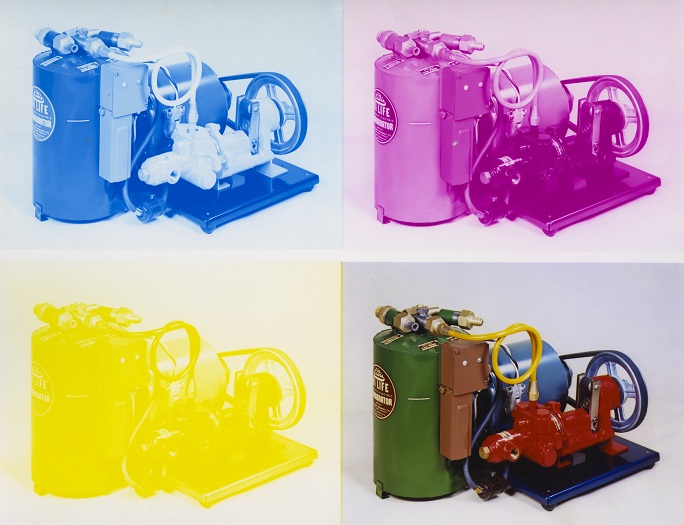
The dye transfer process had been used for the commercial printing of magazines and advertisements up to that time. It involved the separation of three color negatives, made by photographing the original negative with black & white film through three filters (red, green and blue).  The separations were in turn soaked in organic dyes of yellow, magenta and cyan.  The separations would then be meticulously aligned and rolled on to paper.  


The process allows the photographer to obtain higher saturation in nominated colour fields (e.g. red)  without affecting the rest of the colours in the image; a new level of control only provided in recent times by the emergence of digital photography.

Eggleston's work and career was now transformed.  Colour was now not just part of the picture but it was the picture.  A photographer's palette, traditionally limited to the colours that the landscape in front of the camera provided, was now opened up.   

"That is what got me interested. I would look at these advertisements say in Vogue…and I kept thinking, 'I wonder what Eggleston would look like in this process?'”
William Eggleston

The dye transfer process now allowed a certain level of influence and control over the colours presented; providing Eggleston with the medium to truly capture and depict the world he was seeing.  It allowed him to approach the photographic image in some way like a painter may approach a canvas.  The objectivity of the subject now subjected to the colours of Eggleston.  The dye transfer process helps Eggleston inject the ordinary with a heightened level of colour, intensifying the atmosphere and tension in in the frame.  

"It's the observation of the artist that makes the picture great, and the dye-transfer process is a revealing tool [for] his observation of how extraordinary this world is."
Jeff Rosenheim 

"I don’t think anything has the seductivity of the dyes…by the time you get into those dyes it doesn’t look at all like the scene, which in some cases is what you want”


It was also this abstraction of colour that turned what could be deemed photography into art. We were no longer seeing the world through the eyes of a photographer but through that of an artist.

"Art is man's constant effort to create for himself a different order of reality from that which is given to him"
Chinua Achebe


2. Moving Colour

It has been put forward that the advent of the moving picture had a formative influence on the cubist art movement (Glimcher) and that the earliest films of the Lumière Brothers and Georges Méliès, with their inherent movement, sense of time and multi angle perspective, were influential on the works of Picasso and Bracques.

Similarly, movies had an informative affect on the works of William Eggleston.  His images stand as stills from a feature movie.  Their vibrancy, unique glimpsing point of view, framing, sharpness and vividness all contribute to a sense that what we see is part a bigger picture. We often imagine panning further outside his frame, mentally drawing the wider context of his subject matter.


It is in motion picture's advancement in colour technology that appealed most to the work of Eggleston.  The Technicolor process involved the production of three colour negatives and employed actual lithographic printing dyes to produce the rich, over saturated but vivid colours that movies from the period of the 1930s to the mid 1970s were so distinctively memorable.

It comes as no surprise that this striking colour exuberance appealed to Eggleston.

“...it was in North By Northwest that I first discovered how well color can be used”
William Eggleston


Selection of Frames from North by Northwest (Alfred Hitchcock, 1959)


The Red Balloon, Albert Lamorisse, 1956

Eggleston was highly influenced by the prevalence of colour in movies and would subsequently  inspire a generation of American directors in his use of colour to depict the ordinary in America.

The works of Gus Van Sant, David Lynch and Sofia Coppola, to name but a few, have all used Eggleston's approach to colour in their portrayal of "strange" and "disturbing" America.


left, Elephant, Gus Vant Sant, 2003

left, The Virgin Suicides, Sofia Coppola, 1999

left, Twin Peaks, David Lynch, 1990

3. The Colour Red

 "when you look at the (red) dye it is like red blood that's wet on the wall...."
William Eggleston

There is an underlying eeriness to Eggleston's images, none more so when red is used as the predominant colour.

Eggleston's "Red Ceiling" photo, along with "Greenwood Moose Lodge", were his first dye photos and illustrated the full power of his discovered process. It stimulates with its intensity and unsettles with emotional connotations. Eggleston reveals what is not revealed in the frame. His use of lines, be it electric wires or door frames makes us draw the rest of the room and what might be unfolding within.


Eggleston continued to use red throughout his work in very different forms and ways.


4. Everyday Colour


There are many quoted and noted artistic influences on Eggleston's work including: Degas, Andy Warhol, Lichtenstein, Jasper Johns, Edward Hopper, Chardin, Duchamp and Ed Ruscha.

Edward Ruscha said of Eggleston's work, "When you see a picture he’s taken, you’re stepping into some kind of jagged world that seems like Eggleston's World.”

In some ways "Eggleston's World" is not too dissimilar to the world created by Edward Hopper.  There exists an unsettling, jarring undertone in both their depictions of the everyday.  There also exists this cinematic notion that there is more to their images either temporally or physically.  Then there is their mutual understanding of colour and how it can bring the mundane to life.

British author Geoff Dyer once theorised to that Hopper 'could claim to be the most influential American photographer of the twentieth century—even though he didn't take any photographs.'


Gas, Edward Hopper, 1940
Morning Sun, Edward Hopper, 1952

Untitled, Huntsville, Alabama, 1971