Monday, March 25, 2013


Night Scenes

I am particularly interested in photography of the late 1920’s & 1930’s, an era that held the Great Depression , World War 2 and also the glamorous Art Deco movement. 

We rely on writers, painters and Photographers for their evidential records to allow many of us to build up an image of the what these times where like. For example when I think of the social landscape of the 1930’s, I think Art deco, glamorous buildings, elegant clothes and cars etc., but with this glamour brings the darker side of the social realm, the gangster, the criminal and the detective, this is the social landscape I want to delve more into.

It has become apparent to me through the researching process of looking into the social aspects of the 1930’s, the photographer became the investigator/ detective, taking shots of the hidden elements of society that a city would prefer to hide from its counterparts.

It is the night time shots by Brassaï, Bill Brandt and Weegee that captured my attention. Whether their dark night time shots were pre composed or not did not make a difference to me.  They were still able to share that sense that the streets were alive at night. The cast of shadow and light helped create the atmosphere of intrigue, mystery and suspense, some shots are like scenes out of a movie, e.g  The Third Man, Carol Reed 1949.


Brassaï a Hungarian photographer, famous for his book ‘Paris by Night’ (1933), illustrates Paris’s romantic, calm and unpopulated streetscape at night. It was the images that were not able to be published became the most interesting. These images were later published in ‘The Secret Paris of the Thirties’ (1934), these show a more interesting side to Paris at night.
 
‘The Secret of Paris in the Thirties’ allows one enter the nocturnal world of Paris. Brassaï gets acquainted with the intimate side of Paris, taking shots of inside clubs, brothels and prostitutes on the street. This erotic portrayal of Paris at Night was not published until 1976.


‘I was eager to penetrate this other world.’

‘this fringe world, the secret sinister world of mobsters, outcasts, toughs, pimps, whores, addicts, inverts.’

Bill Brandt, adopted as a British photographer, famous for ‘The English Home’ (1936) portrayed the upper class of the South and the working industrial class of the North.


Brandt later brought out ‘A Night in London’ (1938). This document of images portrays a more darker and mysterious Brandt. Examples of these are;

 
‘Footsteps coming Nearer’ (1936),
 
 
‘Street Scene’ (1936)
 
 
‘ Alley off East India Dock Road’ (1937)
 
Influenced by Brassaï , Brandt uses the man as a haunting figure approaching the woman, whereby in Brassaï’s case the men in the image do not seem to have that looming presence that Brandt represents in his.
Another Photographer of this time was Arthur Fellig, aka Weegee. Like Brassaï and Brandt, Weegee was a nocturnal freelance photographer based in New York City. His main attention was following drama, i.e . the latest police chase or ambulance query. He made sure he was first on the scene to grab a photograph for the next breaking news story, selling his shots to newspapers. He took images ranging from a social occasion at the opera, to tenement buildings on fire to the latest mob member being shot. Weegee brought out a documentary book of his work, Nakend City (1945).
                                                                     The Critic, 1943
 
The Tenement Fire
                                                                    Park Avenue 1938
                                                Body of Dominic Didato, Elizabeth Street 1936
Weegee’s shots are more raw/ violent, especially where a murder was concerned.
I hope to explore deeper into Brassaï, Brandt and Weegee’s technique of photography. Each focusing on different lighting, Brassaï's over exposure of the street light, to Brandt's calm moonlight and Weegee's flash. I hope to try and create something of a similar effect to see how difficult it may be to create the perfect picture that captures the right amount of shadow and light through natural light and how the manipulation of Artificial light can be advantageous to a shot. 


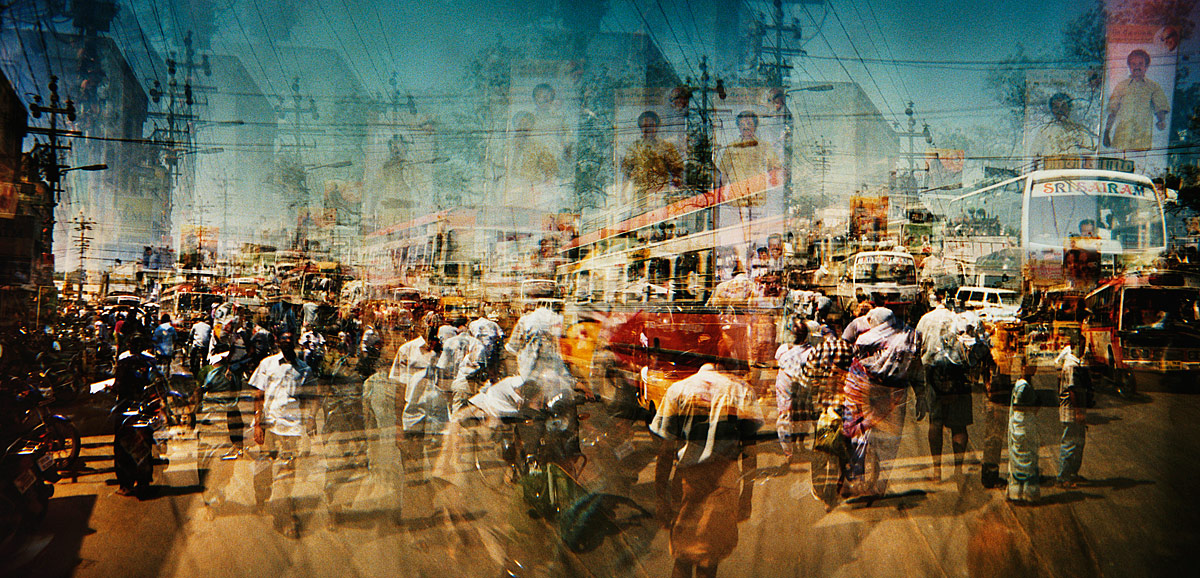
The subject matter I would like to investigate is the work of Swedish photographer Jacob Felländer, with particular reference to technique, composition and subject matter.  His work greatly interests me, specifically the sense of movement he encapsulates through the composition of his work, alongside the great variety of tone and colour produced through his process of development in the darkroom.  His favoured method of multiple exposures of course is not unique to Felländer as is demonstrated by the work of others such as Idris Khan, known particularly in the architectural realm for his representation of the industrial typology studies of the Behcers.  Jacob Felländer's method is more appealing to me however as his images are composed sporadically on location (in contrast to Khan who photographs or scans from secondary sources).

 Gas Holders; Germany, Britain and France (1963-1997)  -  Bernd & Hilla Becher


                  Homage to Benrd Becher (2004)  -  Idris Khan

 
     Cityscapes 6 - Jacob Felländer
A recent Jacob Felländer project of particular interest to me, involved the photographer completing a twelve day worldwide photographic trip, something not immediately unique in the world of photography.  His process however differs from his predecessors, including the Bechers, who choose to compose each frame carefully and methodically with a resultant output of a series of images documenting industrial built typologies. Felländer’s process documented a panorama of each city he visited on a single film, his final image unregulated or revisable until it’s development at the end of his process.  While Felländer’s images are bursting with “visual noise” pierced only by subtle details, the Becher typology images are very clearly defined pieces of work that Khan's reinterpretations serve only to reproduce as an overlay of multiple images.

     Los Angeles - Hong Kong - Bombay  -  Jacob Felländer
The work of Bernd and Hilla Becher is undisputably powerful and will serve only as a reference in this essay.  The writing will focus on the work of Jacob Felländer’s considered but unsystematic use of an inexpensive modified analogue camera, wound forward to expose the film piece by piece to capture his distinctive panoramic frames.  This contrasts heavily with Khan's process and indeed that of the Bechers – reinterpretation of a large 8 x 10 inch view camera objectively positioned relative to the subject, shot only on overcast days and early in the morning.  Another contrast between both photographers is the expression of activity.  Felländer’s images portray the passage of time, “space and perspective drift within a frame” to create a panoramic image filled with movement, colour and tonal variation.  Becher images typically freeze one particular moment, devoid of people or activity, producing something very different. 

    Chenai - Jacob Felländer

Common Colour


I propose to investigate the role of colour in showing the vitality in the banality of everyday life in America with particular focus on the work of the “new colour” photographers of the 1970s. 


Hot Sauce, William Eggleston

In an effort to explore the above, I have identified the themes below as potential areas of interest to explore further.  These themes could then be further supported and augmented by primary research in the form of a series of photographic projects investigating the applications of colour on everyday subject matter.

Acceptance. Investigate the change of attitude towards the use of colour in photography in the 1970s. Although invented in 1907, it took until the 1970s for colour photography to be accepted seriously into the photographic world. 

Black & White are the colours of photography – Robert Frank


Once upon a time there were jobs, Robert Frank, 1955

What were the underlying barriers to its acceptance? What was the tipping point (or points) that leads to its acceptance? What was the role of art movements such as abstract expressionism and pop-art, in its renaissance?

Advocates. William Eggleston was the first proponent of colour photography to be truly accepted by the art world when John Szarkowski showed his work at MOMA in 1976. The publication, William Eggleston's Guide, in which Szarkowski called Eggleston's photographs "perfect," focus on everyday, umdane and trivial subjects.


William Eggleston's Guide, 1976


Perfect? Perfectly banal, maybe…perfectly boring, certainly – Hilton Kramer, New York art critic 

The research aims to focus on Eggleston’s work as well as the other  “new color” photographers of the 70s and 80s such as Stephen Shore and Joel Sternfeld.

Ginger Shore, Stephen Shore, 1977


Uncommon Places, Stephen Shore, 1982


Uncommon Places, Stephen Shore, 1982


Joel Sternfeld

Application. What tangible attributes does colour bring to a photo (life, focus, emphasis, energy etc.)? What were the various processes used and why? (e.g. Eggleston’s discovery of the dye-transfer process in 1973) What meaning (psychological) can be attributed to the use of colour in photography?


Subject. What effect did the application of colour have on the representation of daily life in America?  How did it change the perception of everyday life in America? 


William Eggleston


Sunday, March 24, 2013

Los Alamos


Los Alamos is a collection of images taken by William Eggleston between 1965 and 1974 as he traveled through Southern and Western America.  The book, first published in 2003 to accompany an exhibition at the Ludwig Museum in Germany, presents a selection of prints from a collection of some 2,200 negatives produced by Eggleston during this period.

Los Alamos provides us with further evidence of Eggleston innate attentiveness in capturing the life of the ordinary.  He photographed everyday life, objects and environments, recording them in their richness and unadorned states. 

These images of life never feel like they are studies but more like extended glances into the familiar.  The mundane and ordinary subject matter make the images accessible and understandable.  We’ve seen these things, these people before but maybe not like this. 

Untitled, 1965

This accessibility is further enhanced by the lack of depth and narrow perspective used by Eggleston.  He provides us with a human viewpoint. They are glimpses that we may have made ourselves but now we question whether we really ever saw what was there.  He reminds us that the ordinary is not so ordinary and that there is much vibrancy in the everyday.

Untitled, 1971 

It is this vibrancy and intensity that sets these images apart.  And it is Eggleston’s use of colour that achieves this.  Eggleston used colour at a time when it was only considered suitable for amateur photos or glossy commercial advertisements. It was at a time when "professional" photographers only took pictures in black-and-white. 

Black & White are the colours of photography – Robert Frank


Colour photography allowed Eggleston to use and control colour like a painter may.  Photography, for him, was always an extension of his love for the visual arts.  In 1973 Eggleston had discovered the now out-dated dye-transfer process.  It was a process predominantly used in the advertising industry during the 50s and 60s. The process resulted in giving specific colour’s enhanced saturation and increased intensity. With colour photography and his new found process Eggleston now had the tools to bring the ordinary and mundane to life. 

He shoots like a shutterbug and executes like a painter – Peter Schjeldahl

Eggleston draws us into his frames with his focused, targeted use of primary colour.  We are never left in doubt what or whom the subject of the photo is.  
 
Untitled [and] Untitled

The sky is used often like a curtain backdrop helping to contrast the show in front.  The intensity of the blue providing us with a frame for his subject matter.

Untitled, 1971

The intensity of Eggleton’s colours are rarely matched by the intensity of life underneath.  There are always signs of deterioration of wear and tear, whether it is a car, a sign, a face.  We are reminded of the fragility of ordinary life.  There are always cracks on the surface but maybe we sometime don’t notice them.  Eggleston ensures that we never bore of the mundane and the ordinary and reminds us that is such vibrancy and intensity to what we see everyday.


Untitled, 1965-1968


Thursday, March 21, 2013

Chronologies

Published in 2005, Chronologies draws from a period of some thirty years, from 1975 to 2003, in the career of the American landscape photographer Richard Misrach.  The book collects 125 images re-sequenced into the chronological order.  Representing an explorative study, rather than an anthology or retrospective, the collection reveals a progression of idea, themes and process over a period of 30 years.

"White Man Contemplating Pyramids", Egypt, 1991 [and] "Untitled" On the Beach Series, 2004


Photos are now re-presented out of their original context as a collection of work in themselves. Previously sequenced images are now reorganised into a ”stream of consciousness” providing insight into Misrach’s thinking and evolution as a photographer.  Throughout the journey we see common threads emerge; in subject matter and in composition. Formal and conceptual connections surface as his work weaves in and out of different themes.  There is a sense that we are on a journey of discovery and its not just for our benefit. 

"Train Tracks", 1984 [and] "Tracks", 1989
The book is principally about time.  It reinforces the importance of time within Misrach’s frames while also highlighting its role as the revealer of new meanings and unexpected relationships as the frames become re-arranged consecutively over a 30 year span.  Furthermore, the book becomes a timepiece in itself with every turn of the page representing progression.

Cameras are clocks for seeing -  Roland Barthes

It is the Salton Sea series of photographs that he illustrate so vividly the fragility of our habitation over time. A decade of flooding was caused at this artificial lake in the late 1970s when control of the water levels were lost.  There exists a blurring of the horizon line in Misrach's images of the disaster.  Man made objects rest perilously between the sea and the sky as they are slowly swallowed up.  The objects sit like melting ice caps whose presence will slowly be erased.


"Flooded Snack Bar",  "Submerged Trailer", Salton Sea, 1983

Throughout the work we see Misrach’s ongoing concern with the landscape and humanity’s interaction with it.  He continually reminds us of our subservient role to the forces of nature.   The Salton Sea and Oakland fire series of photos, both representing environmental disasters shot eight years apart, are reminders to our transient existence. Swimming pools remain as traces of our being.


"Diving Board", Salton Sea, 1983 [and] "Swimming Pool", Oakland, 1991

Nobody else has made such a sustained political enquiry into our maltreatment of the wilderness in a vocabulary of such exquisite beauty.—Francis Hodgson


The book begins with a cactus taken from his first series of photos (A Photographic Book) in 1975 and concludes with images from his “On the Beach” series (2003).  The timelessness in the first is replaced with the endlessness of nature in the last. Feelings of privacy are replaced with that of isolation. We are but dots in the ocean. Time has erased the comforting horizon, evident in most of Misrach's work to that date, and replaced it with a celestial view point highlighting our insignificance in the landscape.  


"Ocotillo", 1975 [and] "Untitled", 2005

REFERENCES


http://seesawmagazine.com/misrachpages/misrach_interview.html
http://www.nytimes.com/2006/02/19/arts/design/19geft.html?pagewanted=all&_r=0
http://www.nationmaster.com/encyclopedia/Richard-Misrach#cite_note-Misrach.2C_Richard-2