Monday, April 15, 2013

Public/private, inside/outside as liminal space in photography.

Literature review in progress (Part 1)


The doorstep portrait: intrusion and performance in mainstream American documentary photography by Didier Aubert.

This article looks specifically at twentieth century American documentary photography, and how the considerations surrounding the practice shape the visual outcome of the photographs themselves. There has been long running concern in documentary photographic practice about the intrusion of the photographer into the subject’s world, the legitimacy of the photographs as actual record, the risk of exploitation, and the purpose that the images serve. Documentary photography is often tied to the presentation of the ’worthy poor’ (ref), and to the seeking of equality and social justice for the subjects.

Aubert has identified and focuses on what he calls the ‘doorstep portrait,’ or the ‘threshold’ portrait’, as a format which embodies these concerns, and “can help clarify some of the underlying dynamics” (p.3). In these portraits, the door, porch or threshold is seen as symbolic of the whole house, and the private realm within­ — it is the front, as distinct from the back realm. The house itself is seen as a defining marker of social standing and equality, with house ownership equated to a socially acceptable standard of living. Issues of the negotiation of photographer access, the performance of the subjects and the idea of dignity in the face of adversity also emerge through a reading of the doorstep portrait as a photographic convention.

The doorstep portrait is defined by three conditions which Aubert outlines: the subject is posing; it is a frontal presentation where subjects face the photographer, and they are in front of their house; the setting of the image is  “always a significant yet metonymic part of their houses (doorstep, porch, threshold)” (p.5). Aubert sees images which fit this mold, as metapictures (as defined by WJT Mitchell), which address the single question of “the legitimacy of transforming the private lives of American individuals or families into public visual discourse” (p.5). The work of Dorothea Lange is cited as a key example of this type of image.

These photographs articulate the relationship between photographer, subject and audience, as they grapple with the boundaries of the public and the private. Both the photographer and subject are acutely aware of the interaction taking place and that there is a negotiation occurring. Erving Goffman’s characterisation of social interactions as performances, from his work The Presentation of the Self in Everyday Life (1959), is cited as a means to further understand the dynamic at play. Interestingly, in the pursuit of understanding the social and spatial relationships, Aubert pints out that, “it is easily visualised through photography, if only because the picture itself is always the screen which brings together – yet necessarily separates – sitter and photographer, subject and observer.” (p.9)

The fact that the subjects have some control over their representation and have granted access is central to Aubert’s argument, and the posing and facing the camera is seen as evidence that agreement has been reached. Aubert asserts that the setting itself allows the subjects to “manage their public presentation of privacy” (p.12). Analysis through the lens of Edward T. Hall’s model of proxemics reveals the images to have occurred at the close end of the public distance, or the far end of the social distance. (p.12). However, Aubert is also quick to point out that the presentation of self, whilst within the control of the subjects, still fits within acceptable conventions of ‘decorum’ (p.13).

Aubert also discusses John Biln, who offers a critical commentary on a housing scheme, and associated the doorstep portraits, in an article in Assemblage magazine. Biln uses the doorstep portraits as evidence to benchmark the success of the scheme against. According to Aubert, what Biln highlights is the fact that a house reforms the subject, and that once they have a new house they no longer qualify as suitable documentary portrait subjects. As he describes: “Once the ‘backstage’ of threshold portraits has been reformed, the transition to public performance no longer makes sense, and these families will be expected to conform to socially accepted norms both inside and outside of their homes. The doorstep portrait performance will no longer be relevant, and the traditional narrative of ‘dignity’ that defines the photographic representation of the ‘worthy poor’ will no longer be necessary” (p.14).


Keywords which emerge in the text and are useful for further discussion are facade, front and back, inside and outside, threshold. All of these can be applied in some capacity to photographs, people and architecture, and relate to the issues of privacy I wish to explore. Also emerging from this article is the idea of the spatial and visual coming together - that the photograph is evdence of mediation of the public and private.

Aubert, D. “The doorstep portrait: intrusion and performance in mainstream American documentary photography.”  Visual Studies. Apr2009, Vol. 24 Issue 1, p3-18.


The Holy Ground: Liminality in the Photograph, the Corpse, and Physical Space. by Amy Tudor

Tudor's article is concerned with the way in which the corpse and the photograph can both be considered liminal spaces - as they occupy a space in between other states. Tduor also relates the state of liminality to notiions of the sacred and the profane, as discussed in the work of anthropologists Mar Douglas and Edmund Leach.

"Douglas found that taboo occurred when something was taken out of its prescribed cognitive category and became ambiguous, a state which caused 'cognitive discomfort'" (p.143).

Tudor bases her analysis of the photograph as a lminal space by reference to Roland Barthes' Camera Lucida. The idea that the photograph is never separated from and is forever tied to its referent is take as afundamental starting point. Tudor goes on to define and utilise Barthes' categorization of the photographer as Operator, the audience as Spector, and the subject or thing photographed which Tudor now labels the Spectrum. Reference is also made to the notions of the studium and the punctum.


A photograph that interests the Spectator does so because it advenes (from “advenience”), a word that implies that the photograph has taken the viewer on some “adventure” on viewing it (Barthes 19). Though the photograph is by no means in motion, it still retains the quality of animation, though what it animates – makes alive – is not the referent but the Spectator: “The photograph itself is in no way animated...but it animates me: this is what creates every adventure” (Barthes 20). (p.146).

It is, in fact, that liminal space the photograph wishes to capture or “take.” The more liminal an object’s nature between categories, as we have seen through Douglas and Leach, the more taboo and sacredstyle="font-size: small;"> it becomes, the more, to quote Barthes, it has the potential to 'advene'. (p.146). 

Tudor, A. "The Holy Ground: Liminality in the Photograph, the Corpse, and Physical Space." The International Journal of the Humanities, 2010 Volume 8, Number 6. p.143- 155.


I will take the idea of the ability of a photograph to advene, along with notions of liminality to look at the ways in which photographs function within the specific liminal space between the public and the private.


'The Majesty of the Moment Sociality and Privacy in the Street Photography of Paul Strand' by Mark Whalan.

 
"and something of that experimental view of subjectivity and morality accounts for the power of Strand's photos" 

"that ambition to disarticulate the private from the personal informs and animates these photographs".31

Strand was part of an intellectual circle--the Young Americans--who were fascinated by such instants; they located the interchange between the creative personality and the wider community as the conduit for the aesthetic enrichment so necessary to their vision of social reform. Yet they were troubled by where the boundaries between personality and society, self and other, might lie, when reconciling individual and community in a relation of mutual nourishment. Strand found that these complex and highly abstracted
questions--the participation of personality in community and, indeed, how these things were mutually constituted, and how structures of time either reinforce or critique a mass-production economy--could be made concrete in a photography that tested the limits of the privacy of others. Was personal synonymous with private? Was privacy reducible to a naked individualism that was anathema to community? Did art have special exemptions from the rapidly shifting sands of public feeling (and national jurisprudence) around privacy? When did communal affiliation tip into the affect of intrusion? The risky business of playing with privacy in photographs became the perfect vehicle for mobilizing these questions in aesthetic form.

Whalan, M. 2011, 'The Majesty of the Moment Sociality and Privacy in the Street Photography of Paul Strand', American Art, 2, p. 34.


Michael Wolf

Wolf's project, Real Fake Art is an example of a contemporary project which utlises the convention of the doorstep portrait.

 
Chuck Close


Lee Friedlander


I feel also, that despite the lack of people in the images the Bastard Chair series mentiuoned perviously is also relevant, as many of these are also located near doorsteps, and they also depict a certain amount of bleeding of the private in to public space.


Further Texts 

Nour Dados. Liminal transformations: folding the surface of the photograph. Conserveries
mémorielles#7 | 2010: Seuils, Thresholds, Soglitudes


Saturday, April 13, 2013

The city, underground.


Subway
Bruce Davidson, 1986

Subway was first published in 1986, six years after Bruce Davidson began photographing in the New York underground train system. The project led to a praised exhibition at the International Center for photography in 1982, commenting on Davidson´s use of color and style.
The photos of the New York subway shows an overheated, overcrowded, and potentially violent setting for muggings, drug-related emergencies, and nudity. When looking through the series it seems clear that what truly interested Davidson was not the violent conditions, but rather the people who converged on the subway. 

“I wanted to transform the subway from its dark, degrading, and impersonal reality into images that open up our experience again to the color, sensuality, and vitality of the individual souls that ride it each day.”
Davidson work out from a context, often of contemporary relevance, such as the New York subway was in the 1980´s. The subway was know for not running, being unsafe, and full of graffiti, but he describes it as sexy, sensual and sometimes extremely grim. 


The subway is an attractive setting to document because of its uniqueness as a public room, a showroom for the city’s demographic diversity and the compressed individual. The subway is an unpredictable, anonymous and enclosed environment containing a diverse range of individuals who, despite the public setting, often remain in their own worlds.


Initially Davidson was shooting with a black-and-white Leica film-camera, as he did in the former projects Brooklyn Gang and East 100th Street, but he then started to explore in color. 


When using color the tags starts to interact with the peoples cloth, skin tones and creates a dialogs across the image. And with the use of a strobe flash he further intensifies the colors contrasting them to a deep black, which amplifies the violence of the subway. He transforms the subway into an aesthetic experience, revealing things that is commonly overlooked. 
“In transforming the firm, abusive, violent and yet often serene reality of the subway into a language of color, I see the subject as a metaphor for the world in which we live today.”


For most subway photographers, such as Walker Evans, remaining unnoticed by their subjects is a crucial part of the process, in order to capture the subject free of projections. Walker Evans secretly took pictures of people because he wanted to portrait people unaware of a cameras presence. Davidson have a more confrontational method that shows drama, personality, strangeness and beauty. His method is different because he deliberately makes his presence know by carrying his camera around his neck. When a scene or a subject caught his attention he would approach, explain his project and ask for their permission to shoot. He would then ask them to look into the camera or continue the scene.


I was looking at the map when the doors opened and in came a fierce youth with a deeply gouged scar running across his face.
He sat down across the aisle from me, gave me a hard look, and said in a low, penetrating voice, “Take me picture, and I´m going to break your camera.” I quickly said, “I don´t take pictures without people´s permission, and I always send them prints.” I reached into my jacket pocket for my portfolio, walked over to him, and slowly leafed through the sample photographs while sitting on the edge of my seat. After looking, he paused for a moment, then turned to me and said, “Okay, take my picture.” I went back to my seat and began to photograph, taking a few frames. Then I wrote down his address. He left, disappearing along the platform as the train gained speed. A couple of weeks later I sent him some prints of our encounter together, but the post office returned them with a red stamp on the envelope that said: RETURNED TO SENDER – MOVED – LEFT NO ADDRESS.

Where Evans work was about capturing private moments unfolding in public, Davidson´s subjects are aware and often posing for the camera. An interesting question is if we learn more about the person from unconscious or conscious behavior?


Tuesday, April 9, 2013

Doorstep photography - the private made public

It was my original proposal to make a series of images which deal with the themes of privacy, voyeurism, intimacy and focused on photography which expresses tensions at the thresholds between the public and the private realm. This proposal has now transformed, and is no longer about making a series of images, but about collating a series of images which talk about the themes originally identified.

To focus the research, photography of specifically of people on stairs was selected to locate relevant images for discussion. Initial investigation has identified a huge number of images on stairs - many posed and commercial shots, some snapshots and mostly images of people walking on stairs. General google image searches were conducted to locate images, and now more specific keyword searches on Flickr have begun.


Google Image search results - people sitting on stairs.
 
Google Image search results - people sitting on stairs.


The huge volume of random images, show that photography on stairs is a strong recurring theme. But how to make sense if so many varied images, take under such a variety of conditions?  I feel that focusing (as much as possible) primarily on work by documentary photographers, street photographers, artists and dedicated projects will give a further targeted pool of images to examine. It is also emerging that images should be narrowed to doorways and doorsteps, rather than simply steps in general. This may include static portrait style shots or other activity, or movement through the threshold zone of a doorway or doorstep. This is more in keeping with the original research intention.


So far, a number of interesting photographers, artists, images, projects and exhibitions have been located which discuss the themes.

Interesting resources which have been identified so far. These form a snapshot of my thinking so far, and through investigation of these resources I hope to establish a more coherent proposal and direction for the essay.


Key Articles
Didier Aubert. “The doorstep portrait: intrusion and performance in mainstream American documentary photography.”  Visual Studies. Apr2009, Vol. 24 Issue 1, p3-18.

Elizabeth Chapman. “A response to Didier Aubert” Visual Studies, Vol. 25, No. 2, September 2010

These article deal with doorstep photography as a sub-genre of documentary photography. As Chapman says, Aubert “shows the methodological and ethical concerns routinely encountered and resolved when the documentary photographer wants to display the private for public consumption. Doorstep photography is the conventional (inevitable?) ‘answer’ to the perennial problem of gaining access yet avoiding intrusion, unwanted exposure.”

Artists
Sam Kiang Li: At Our Doorsteps
Li has photographed residents in his apartment building in Singapore.
http://invisiblephotographer.asia/2012/05/10/photoessay-atourdoorsteps-samkangli/

Michael Wolf's project are of continued interest as a number of his projects talk about issues of privacy and voyeurism. 


 Michael Wolf - Bastard Chair #17
 Michael Wolf - Bastard Chair #20


Nigel Henderson (part of the Independent Group), and associated with the Smithsons. Some of his work focuses on the streetscape and interface between buildings and the street. In particular it documents  children playing on the street.


Nigel Henderson Bethnal Green, 1949-52
Nigel Henderson Chisenhale Road, 1951


Exhibitions


John Goodman Tremont Street #3, Boston, 1978
from the exhibition
Exposed: Exposed: Voyeurism, Surveillance and the Camera

Exposed: Voyeurism, Surveillance and the Camera
This exhibition focuses on the idea of the unseen photographer. This is of interest as this idea implies that the subject doesn't know they are being photographed, or exactly when and what image(s) are captured. It also implies a potential invasion of privacy.
http://www.tate.org.uk/whats-on/tate-modern/exhibition/exposed

The Skinned City
From the exhibition description-
"In an attempt to observe and grasp our surroundings, all works exhibited are focusing on margins rather than actual buildings, on the liminal spaces and ambiguous boundaries marking out the city and the different places within it. Accordingly, the show promotes some rather idiosyncratic takes on the world around us: often on the edges of the visible, the works unpeel the city space and its various layers – not to arrive at a ‘deeper truth’, but to undo the many planes of a cityscape."

http://www.guestprojects.com/past/skinned-city/ 

I like the premise of this exhibition, and think there is potential in discussing imagery of doorsteps and thresholds along these lines. However, there is limited imagery of the exhibition itself, and none of the images seems to capture the concern with the public and private I see.


Additional Texts

Whalan, M. 2011, The Majesty of the Moment Sociality and Privacy in the Street Photography of Paul Strand, American Art, 2, p. 34,

Nour Dados. Liminal transformations: folding the surface of the photograph. Conserveries
mémorielles#7 | 2010: Seuils, Thresholds, Soglitudes


Further Research threads


Liminal space - Susan Sontag, Walter Benjamin...


Monday, April 8, 2013

The Underground.


For the essay I wish to take a closer look at photographers investigating life in the subway system. 
The subway shows the cities density like nowhere els in the city, as a place were the entire demography of a city not only meets but in most cases are forced passed each individuals “personal-space”. The diversity and the unique ethnicity of each individual becomes clear in the subway, as a place were people with different backgrounds come together. The group Improv Everywhere made a Subway yearbook in 2009, showing the variation of the people coming and going on the trains of New York. 


Riding the subway is a chance to clearly understand peoples psychological behavior when cramped closely together. It is an experience of alternately judging people and ignoring them by gazing in an other direction. When looking at Walker Evans photos not much has changed, what seems different is merely their way of dressing. People still tolerate each others presence the same way.
As a contrast then looking at Michael Wolfs “Tokyo Compression” where people are stuffed into the trains in Tokyos cramped subways.


Many are called
Walker Evans, 1966
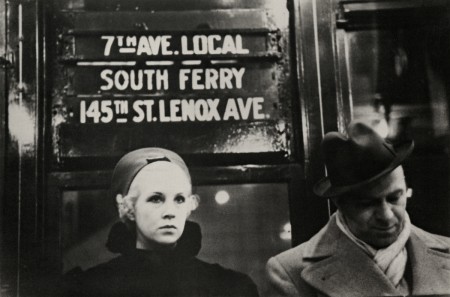
Between 1936 and 1941 Walker Evans and James Agee documented the depression-era in rural America1, one of the most provocative books in american literature. While working on this book the two of them also worked together on the less known, but equally important project, “Many are called”2.


With the subway portraits Evans turned away from the carefully composed images of poor farmers and architectural details which had up till then characterized his work. Over a period of 3 years he returned to the New York subway photographing people sitting opposite him with a miniature camera hidden in his coat.


The project makes no political argument, but presents a cross section of people from the New York Subway. In order to achieve the spontaneity he limited himself from farming his pictures to only releasing the shutter hidden in his sleeve. The result is a directness to the person in front of him, they appear off center and pushed to the edge of the photos.


Evans captures people in typical subway behavior, daydreaming or a sleep, and some stare back at him – suggesting he must have looked quite intensely at them to begin with. 


Most of the passengers are white and represent a range of social classes. When choosing the subjects he was attracted to the people with a specific facial expression and unusual clothing. 
When working the images Evans would make precise selection and cropping of his images along with the layout in which they were shown. The book remained unpublished until 1966 when an exhibition of his subway portraits were shown at the Museum of Mordern Art in New York.
James Agee wrote the introduction for the book Many Are Called;
“The photographs were made in the subway of New York City, during the late thirties and early forties of the twentieth century. The effort, always, has been to keep those who were being photographed as unaware of the camera as possible. To anyone who understands what a photograph can contain, not even that information is necessary, and any further words can only vitiate the record itself. Because so few people do understand what a photography can contain, and because, of these, many might learn, a little more will, reluctantly, be risked. Those who use the New York subways are several millions. The facts about them are so commonplace that they have become almost as meaningless, as impossible to realize, as death in war. These facts- who they are, and the particular thing that happens to them in a subway- need brief reviewing, and careful meditation. They are members of every race and nation of the earth. They are of all ages, of all temperaments, of all classes, of almost every imaginable occupation. Each is incorporate in such an intense and various concentration of human beings as the world has never known before. Each, also, is an individual existence, as matchless as a thumbprint or a snowflake. Each wears garments which of themselves are exquisitely subtle uniforms and badges of their being. Each carries in the postures of his body, in his hands, in his face, in the eyes, the signatures of a time and a place in the world upon a creature for whom the name immortal soul is one mild and vulgar metaphor.”
3
Tokyo Compression
Michael Wolf


In Tokyo, cramped subway conditions and aggravated commutes are a normal part of the city rush hours. Michael Wolf captured these extreme conditions and the effect it has on the people in the series “Tokyo Compression”. People hardly has room to breath, but because housing in the city is unaffordable commuters must spend houres in and out of Tokyo everyday. 
"This is the result of capitalism gone wild," says Wolf.


Tokyo is known for it´s huge urban population but this series shows how packed city life really is in Japan. Wolf photographed the Tokyo subway for 15 years and published the “Tokyo Compression” over 3 installments. 
Wolf stands on the platform as the doors closes, and thereby unwillingly captures his subjects. Some stare directly into the lens, others closes their eyes. The images shows exhausted, discomfort, and annoyed people. “They are unwilling subjects trapped in the train window… The images create a sense of discomfort as his victims attempt to squirm out of view or simply close their eyes, wishing the photographer to go away.”1

Wolf first started photographing the subway when he reported a nerve gas attack in 1995. He then spent 20 days photographing the morning rush hours portraying people on their way to work.


1 ”Let Us Now Praise Famous Men”, 1941.
2 First published in 1966
3 http://neonmamacita.com/2012/11/third-class-carriage.html
4 http://photomichaelwolf.com/#